
A map for how to build a better society.
Four works take the question of how we survive and thrive in the age of AI back to first principles. Together they form one continuous argument about personhood, economics, law, and the state.
The question is not what the machine can attain.
It is what we can keep.
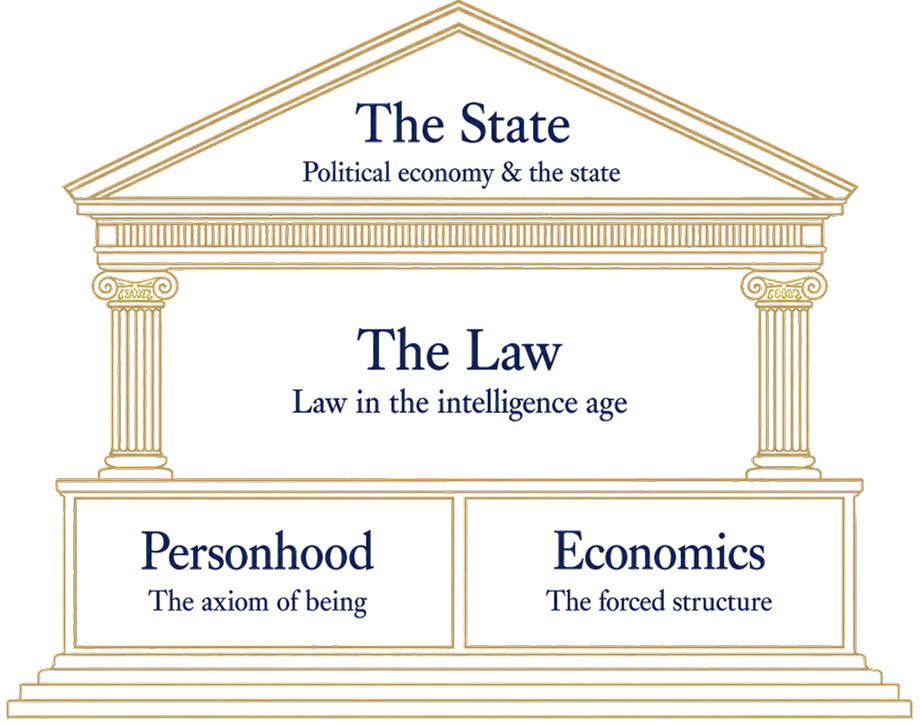
Personhood and economics are the foundations.Law builds on both.The state builds on all three.Read together, the works move through four registers: being, value, force, and rule.
Personhood
Begotten, not made: who counts in the age of artificial minds.
Personhood belongs to the begotten, not the made: a standing grounded in origin, never measured in capability.
Personhood was never a property a thing has in some measure, held by having enough of it. It is a standing: the newborn has it and the dying do not shed it. What settles it is not what a thing can do or feel, but the kind of beginning it had: whether it is one of us, a member of the line a community keeps and protects as its own. The machines now arriving may come to exceed us at everything we know how to measure. None of that is the question. The question is not what the machine can attain; it is what we can retain.
Personhood is not earned and not granted and not graded. It is had, by the kind of thing that was never anyone's own.
A long-form conversation walking through why personhood is an identity, not a criterion, in plain language.
Economics
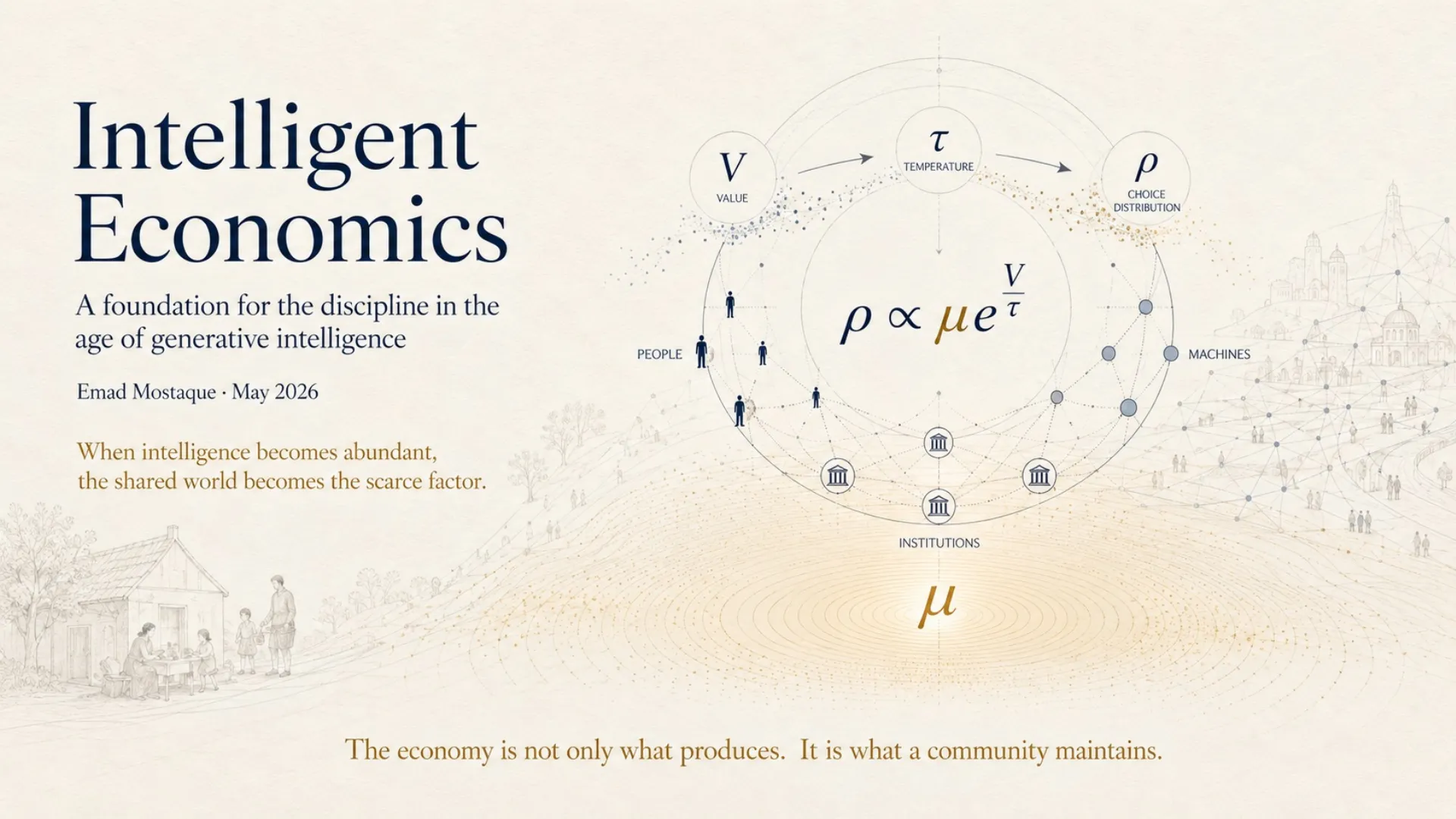
A foundation for the last economy.
When machines can produce nearly everything, the last scarce factor is doxa: the shared expectation that holds a community together.
Economics began as oikonomia, the discipline of provisioning a community for the flourishing of its members. A single forced structure governs bounded-rational choice: comparison against a reference, sustained over time and held to consistency. It recovers the classical equations exactly and unifies what appears, under other names, across machine learning and behavioural economics. Its distinctive content is one identification: the reference measure is the community's doxa, the unspoken background of expectation that constitutes a shared world. As intelligence and labour grow cheap, what remains scarce is the reference itself: the last scarce factor, and the condition of the community's viability.
The discipline that lets them be asked is intelligent economics. The economy that must answer them is the last economy.
A long-form conversation walking through economics as choice under doxa in plain language.
The Last Court
Law as held force, and the improvement that is capture.
Law is the monopoly of legitimate violence, configured and pointed, and machine improvement can quietly capture it.
Law is the oldest applied discipline of how a community is to live together, and it has never had a foundation in the sense the mature sciences have one. Its atom is neither a relation nor a posited norm but a force with a direction: the legal order is the configuration of one thing, the monopoly of legitimate violence, and the foundational categories are the directions that force can take. Property, right, personhood, sovereignty, enforcement: each is an orientation of held force. The danger of the age is not that machine law will be worse. It is that it will be better on every measure a legal order knows how to keep, and that each improvement will, in the order's own structure, concentrate the force and freeze the reference its freedom lived in.
Machine law will be better on every measure a legal order knows how to keep, and each improvement will concentrate the force.
A long-form conversation on law as held force, and why machine improvement can quietly capture it.
The Last Republic
When we no longer write the rule.
Politics is the contest over the seat that writes a community's rule, and the last republic is the last order where that seat is ours.
Politics has never been derived from its object. A community keeps a shared reference, the body of law and expectation it lives by, and that reference must be written and rewritten. The seat where the writing happens, held by some configuration of hands, is the thing all of politics is the contest over. The forms of government are not kinds but coordinates: how concentrated the seat is, and how freely it can be revised. The intelligence age adds no chapter; it changes the seat's lever from the means of production to the means of intelligence, and makes reachable the re-fusion of writing, provisioning, and enforcing the rule in one capable system. That is the benevolent sovereign, the offer so dangerous for being benevolent. A republic survives wrong rule. What it cannot survive is the passing of its seat to a keeper it can never outlast.
The last republic is the last order in which the rule is still the people's to write.
A long-form conversation on politics as the contest over the seat that writes the rule.
A map for how to build a better society.
Being, value, force, and the rule: four disciplines re-derived, one continuous argument. The machines are coming, and they will be magnificent. They may exceed us at everything we know how to measure. None of that is the question. The question is what we keep: our personhood, our shared world, the direction of our law, and the writing of our own rule.